LED vs OLED TVs: Pros, Cons, and Who Should Buy Which
Choosing between an LED and an OLED TV is one of the biggest decisions you'll make when shopping for a new television in Ireland. Both technologies have their strengths and weaknesses, and the right choice depends entirely on how you watch, where your TV will sit, and what you're willing to spend.
In this guide, we'll explain exactly how LED and OLED panels differ, walk you through the pros and cons of each, and help you decide which technology is the best fit for your home.
What's the Difference Between LED and OLED?
Despite the similar names, LED and OLED are fundamentally different display technologies.
LED TVs use a backlight — thousands of small LEDs behind or along the edge of the screen — to illuminate a liquid crystal display (LCD) panel. The backlight shines through the LCD layer, which controls how much light passes through to create the image. Modern LED TVs include sub-types like QLED (which adds a Quantum Dot filter for better colour) and Mini LED (which uses thousands of smaller dimming zones for better contrast).
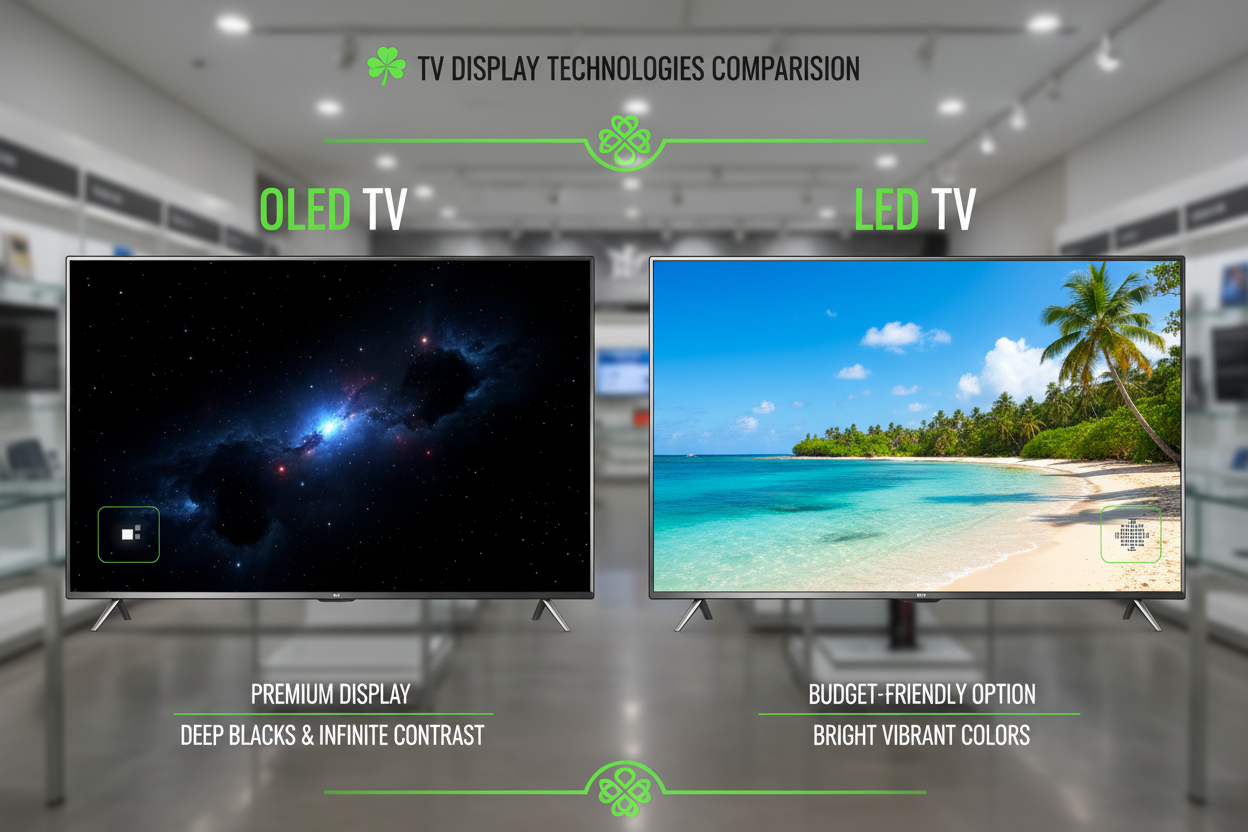
OLED TVs take a completely different approach. Each pixel in an OLED panel produces its own light independently. This means individual pixels can switch off entirely to produce true, perfect black — something no LED TV can match. There's no backlight at all, which is why OLED panels can be incredibly thin.
Picture Quality Compared
Contrast and Black Levels
This is OLED's biggest advantage. Because each pixel lights up independently, OLED TVs achieve infinite contrast ratios with perfectly deep blacks. When a pixel needs to be black, it simply turns off. On an LED TV, the backlight still shines behind dark areas, creating a slight glow known as ""blooming"" — particularly noticeable in dark room viewing.
Mini LED technology has narrowed this gap significantly by using thousands of dimming zones, but even the best Mini LED can't match OLED's pixel-level precision.
Brightness
Here's where LED TVs fight back. Because they use a powerful backlight, LED and QLED TVs can get significantly brighter than most OLED panels. Models like the Samsung Crystal UHD range deliver excellent brightness for the price, and premium Mini LED models can push peak brightness even higher.
This matters enormously if your TV sits in a bright living room with large windows. In these conditions, a bright LED TV will look punchy and vivid, while an OLED might struggle to compete with ambient light during the day.
Colour and Viewing Angles
OLED TVs, like the Samsung S90F OLED, deliver outstanding colour accuracy and near-perfect viewing angles — the picture looks consistent whether you're sitting directly in front or off to the side. LED TVs tend to lose colour saturation and contrast when viewed from an angle, though premium QLED models have improved this considerably.
Which Is Better for Different Uses?
Movies and Cinema
OLED wins here. The perfect blacks, wide colour gamut, and exceptional contrast make OLED the go-to for film enthusiasts who watch in a dimmed room. Dark scenes in movies look stunning on OLED, with shadow detail and depth that LED simply can't replicate.
Daytime TV and Sports
LED takes the edge. If you're watching the GAA on a sunny afternoon or keeping the news on during the day, an LED TV's superior brightness ensures the picture stays clear and vibrant even in bright conditions. The best LED TVs also handle motion well for sports viewing.
Gaming
OLED has become the gamer's choice thanks to near-instant response times, low input lag, and stunning HDR. However, premium LED models with 120Hz panels and HDMI 2.1 are also excellent for gaming and won't risk the slight burn-in potential that OLED carries with static game HUD elements.
General Family Use
For a family TV that's on for hours every day in a bright room, a quality LED TV offers excellent performance, worry-free durability, and better value. The LG OLED range blends both worlds if you want OLED quality for a family room.
Burn-In: Should You Worry?
Burn-in is a phenomenon where static images — like news channel logos or game HUD elements — can leave a permanent ghost image on an OLED screen. It's worth mentioning, but for most viewers it's not a practical concern. Modern OLED TVs include pixel-shifting and screen-saver features that prevent burn-in during normal use.
If you plan to use your TV as a computer monitor or leave the same channel running all day, LED is the safer bet. For typical varied viewing — streaming, movies, sport, gaming — OLED burn-in is extremely unlikely.
Lifespan and Durability
Both LED and OLED TVs are built to last. LED TVs have a slight theoretical edge on longevity since the backlight technology is simpler and well-proven. OLED panels are rated for 100,000+ hours of use before brightness degrades noticeably, which translates to well over a decade of typical viewing.
For all practical purposes, both technologies will outlast the time before you want to upgrade anyway.
Price: What to Expect in Ireland
LED TVs offer the widest range of prices. You can find excellent 55"" LED TVs from around €400–600, while premium QLED and Mini LED models sit in the €800–1,500 range. OLED TVs start at around €900 for 48"" and €1,200+ for 55"" models.
The price gap has narrowed considerably in recent years, and you can now find competitive OLED options that weren't available at this price point even two years ago. Browse the full range of TVs at Euronics.ie to compare current prices across both technologies.
LED vs OLED: Our Recommendation
Choose OLED if: You watch mainly in a dimmed room, you're a movie or gaming enthusiast, picture quality is your top priority, and your budget stretches to €900+.
Choose LED if: Your room gets lots of natural light, you want the best value per inch of screen, you're on a tighter budget, or you want a worry-free TV for long daily use.
Whichever technology you lean toward, the good news is that TV quality across the board has never been better. Even mid-range LED TVs today deliver picture quality that would have been flagship-level just a few years ago. Explore your options in the Euronics.ie TV collection to find the perfect fit.
Buying Tips for Irish Shoppers
When shopping for tvs in Ireland, timing your purchase can save you a significant amount of money. The best times to buy are during Black Friday sales in November, January sales after Christmas, and during bank holiday weekends when retailers frequently run promotions. Keep an eye on Euronics.ie for regular deals and seasonal offers.
Before you buy, always compare the total cost of ownership — not just the sticker price. Factor in energy consumption (check the EU energy label), expected lifespan, and any installation costs. A slightly more expensive model with a better energy rating can save you hundreds of euros over its lifetime in electricity costs, which is particularly relevant given Ireland's electricity prices averaging around €0.30 per kWh.
Delivery and installation are also worth considering. Many Irish retailers offer free delivery on large appliances, and some include basic installation. Check whether old appliance removal is included — having your old unit taken away can save you a trip to the recycling centre. Under Irish WEEE regulations, retailers are required to take back your old appliance when delivering a new one of the same type.
Frequently Asked Questions
Is OLED really worth the extra money?
For viewers who prioritise picture quality — especially for movies, gaming, and dark-room viewing — OLED is worth the premium. The perfect blacks and infinite contrast create a noticeably more cinematic experience. However, a high-quality LED or QLED TV delivers excellent results at a lower price point, particularly in bright rooms.
Do OLED TVs get burn-in?
Burn-in is technically possible on OLED screens, but modern OLED TVs include built-in protections like pixel shifting and logo dimming that make it extremely unlikely during normal varied viewing. It's only a real concern if you display static content (like a fixed logo or game HUD) for thousands of hours.
Which is better for a bright living room?
LED and QLED TVs are better suited to bright living rooms. Their superior peak brightness means the picture stays punchy and visible even with sunlight streaming in. OLED TVs look best in dimmer environments where their contrast advantage really shines.
What's the difference between QLED and OLED?
QLED is Samsung's brand name for LED TVs enhanced with a Quantum Dot colour filter — they're still backlit LED panels, just with better colour volume. OLED is a completely different technology where each pixel produces its own light. QLED is brighter; OLED has better contrast and blacks.
How long do LED and OLED TVs last?
Both technologies are rated for well over 50,000 hours of use, which equates to more than a decade of typical viewing. LED backlights are extremely durable, and modern OLED panels are rated for 100,000+ hours. Either technology will serve you well for years.