4K vs 8K TVs: Is 8K Worth It in 2026?
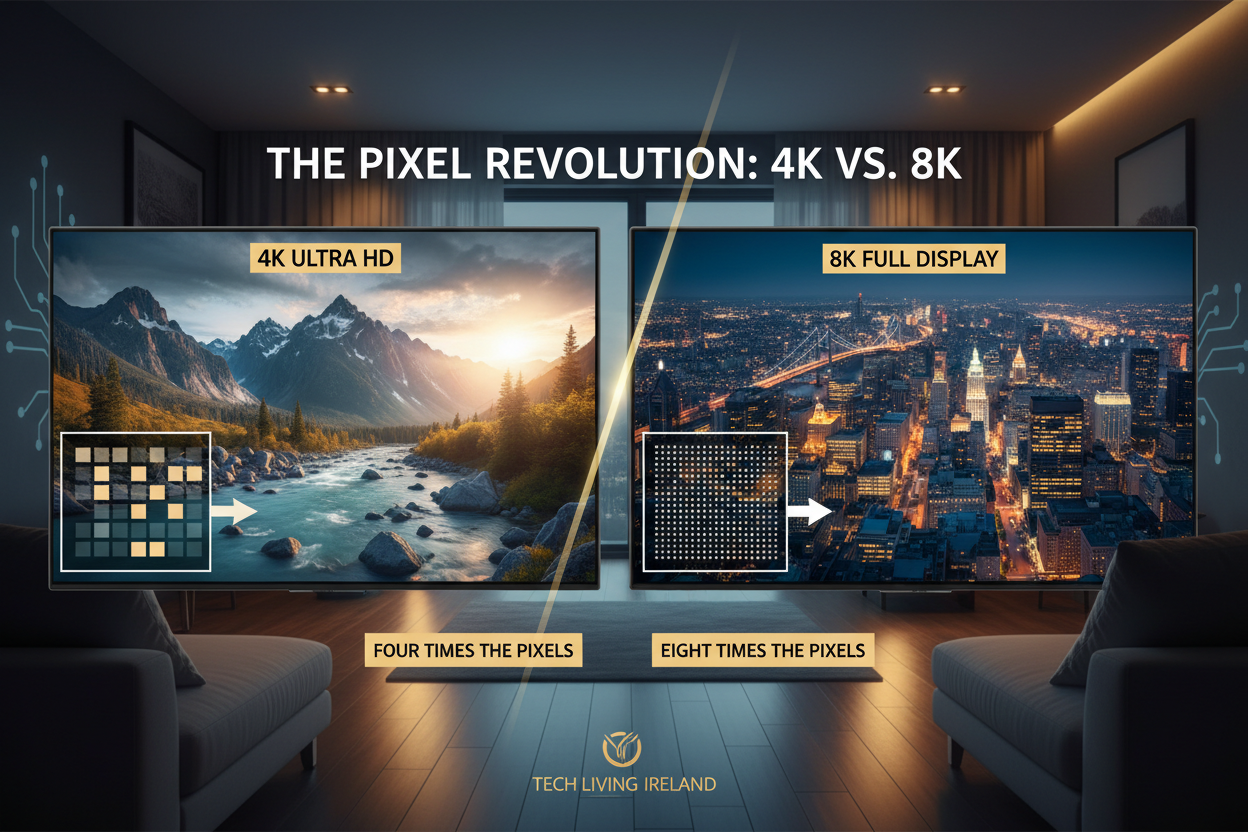
With 8K TVs now appearing on the market, you might be wondering whether it's time to skip 4K and jump straight to the next generation. It's a fair question — after all, 8K offers four times the pixel count of 4K. But does that translate into a meaningfully better viewing experience in your living room?
In this guide, we'll explain the real differences between 4K and 8K resolution, look at the current content landscape, and help you decide whether 8K is genuinely worth the investment in Ireland right now.
What Do 4K and 8K Actually Mean?
4K (also called Ultra HD or UHD) delivers a resolution of 3,840 × 2,160 pixels — that's over 8 million pixels on screen. It's the current standard for premium TVs and is supported by virtually all streaming platforms, Blu-ray discs, gaming consoles, and broadcast upgrades.
8K doubles the pixel count in both directions to 7,680 × 4,320 pixels — a staggering 33 million pixels. On paper, that's four times the detail of 4K.
But here's the crucial question: can you actually see the difference?
Can You Tell the Difference?
The honest answer is: in most real-world situations, no. The human eye's ability to perceive the difference between 4K and 8K depends on two factors — screen size and viewing distance.
For most Irish living rooms, where you're sitting 2–3 metres from the TV, you'd need a screen larger than 75"" to notice meaningful improvements from 8K over 4K. On a 55"" or 65"" screen at typical viewing distances, the extra pixels are essentially invisible.
Where 8K does make a visible difference is on very large screens (85""+) viewed from closer distances, or for professional applications like digital signage and content production.
The Content Problem
This is the biggest practical issue with 8K in 2026. There is very little native 8K content available. Netflix, Disney+, Amazon Prime Video, and other major streaming services in Ireland max out at 4K. RTÉ and Virgin Media don't broadcast in 8K. Even Blu-ray tops out at 4K. The PS5 and Xbox Series X support up to 4K/120fps but not 8K gaming in any practical sense.
8K TVs use AI upscaling to convert lower-resolution content to fill the extra pixels, and the results are impressive — but you're still watching upscaled 4K content, not native 8K.
4K TVs: Where the Real Value Is
4K has hit its stride in 2026. The technology is mature, content is abundant, and you can get genuinely exceptional 4K TVs at every price point. Models like the Samsung Neo QLED 55"" Mini LED and the Samsung Neo QLED 75"" Mini LED deliver stunning picture quality with technologies like Mini LED backlighting, Quantum Dot colour, and advanced AI upscaling.
The sweet spot for most Irish buyers is a high-quality 4K TV in the 55""–75"" range. At these sizes and typical viewing distances, 4K delivers all the sharpness and detail your eyes can perceive, and the money you save by choosing 4K over 8K can be invested in better panel technology (OLED or Mini LED), better sound quality, or simply a larger screen.
8K TVs: Who Are They Actually For?
8K TVs make sense for a very specific audience. You'd genuinely benefit from 8K if you want a screen larger than 85"", you sit unusually close to your TV, you're future-proofing for 8K content that may arrive in the coming years, or you simply want the absolute cutting edge of display technology regardless of cost.
For the vast majority of viewers in Ireland, 8K is a luxury that doesn't deliver proportional returns on investment — especially when that money could buy a significantly better 4K TV.
Future-Proofing: Is 8K Worth Waiting For?
The 8K content ecosystem will grow over time, but it's moving slowly. Japan's NHK has pioneered 8K broadcasting, and we'll likely see some streaming content in 8K by 2027–2028. But even optimistic projections suggest it'll be several years before 8K content becomes mainstream in Ireland and Europe.
Meanwhile, 4K isn't going anywhere. It's the dominant standard for content production worldwide and will remain so for years. Buying a premium 4K TV today doesn't mean you're buying outdated technology — you're buying into a mature, well-supported ecosystem.
Our Recommendation
For most Irish buyers in 2026, 4K is the clear winner. The combination of mature technology, abundant content, excellent panel options, and strong value makes 4K the smart choice. You can view the full range of 4K TVs at Euronics.ie to find the right model for your budget.
Put the money you'd spend on 8K toward a premium OLED or a top-tier Mini LED 4K TV instead — you'll see a far bigger improvement in your daily viewing experience than the extra pixels of 8K would deliver.
Buying Tips for Irish Shoppers
When shopping for tvs in Ireland, timing your purchase can save you a significant amount of money. The best times to buy are during Black Friday sales in November, January sales after Christmas, and during bank holiday weekends when retailers frequently run promotions. Keep an eye on Euronics.ie for regular deals and seasonal offers.
Before you buy, always compare the total cost of ownership — not just the sticker price. Factor in energy consumption (check the EU energy label), expected lifespan, and any installation costs. A slightly more expensive model with a better energy rating can save you hundreds of euros over its lifetime in electricity costs, which is particularly relevant given Ireland's electricity prices averaging around €0.30 per kWh.
Delivery and installation are also worth considering. Many Irish retailers offer free delivery on large appliances, and some include basic installation. Check whether old appliance removal is included — having your old unit taken away can save you a trip to the recycling centre. Under Irish WEEE regulations, retailers are required to take back your old appliance when delivering a new one of the same type.
What to Consider Before You Buy
Before making your final decision, there are a few practical considerations specific to Irish homes that are worth thinking through. First, measure the space carefully — Irish kitchens and utility rooms can vary significantly in size, particularly in older homes and city apartments. Always leave clearance for ventilation, door opening, and access to connections.
Think about your household's specific needs. A couple in a Dublin apartment has very different requirements to a family of five in a detached house in Cork. Consider how often you'll use the appliance, what capacity you genuinely need, and which features you'll actually use versus those that sound impressive but add cost without real benefit.
Energy efficiency deserves special attention in Ireland. With electricity costs among the highest in Europe, choosing an A-rated or B-rated appliance can result in meaningful savings over time. The EU energy label makes it straightforward to compare — look for the colour-coded scale and annual energy consumption figure in kWh. Even a difference of 50 kWh per year translates to roughly €15 annual savings, which adds up over the 10+ year lifespan of most major appliances.
Finally, consider warranty and after-sales support. Buying from established Irish retailers like Euronics ensures you have local support if anything goes wrong. Some brands offer extended warranties, and it's worth checking whether the retailer offers their own protection plans for added peace of mind.
Frequently Asked Questions
Is 8K TV worth buying in 2026?
For most viewers, no. There's very little native 8K content available, and at typical screen sizes and viewing distances, the difference between 4K and 8K is nearly imperceptible. Your money is better spent on a high-quality 4K TV with better panel technology like OLED or Mini LED.
Can you see the difference between 4K and 8K?
At typical Irish living room viewing distances (2–3 metres), you'd need a screen larger than 75 inches to notice any meaningful difference. On 55 inch and 65 inch screens, the difference is essentially invisible to the human eye.
What resolution do Netflix and Disney+ stream at?
Netflix and Disney+ currently stream at up to 4K (Ultra HD) with HDR support. Neither service offers 8K content. Most other Irish streaming services, including RTÉ Player, stream at up to 1080p Full HD.
Will 8K TVs become cheaper?
8K TV prices will continue to fall over time, just as 4K prices did. However, even when prices drop, the lack of native 8K content means the value proposition won't change dramatically in the near term. A premium 4K TV will likely remain the better investment for several more years.