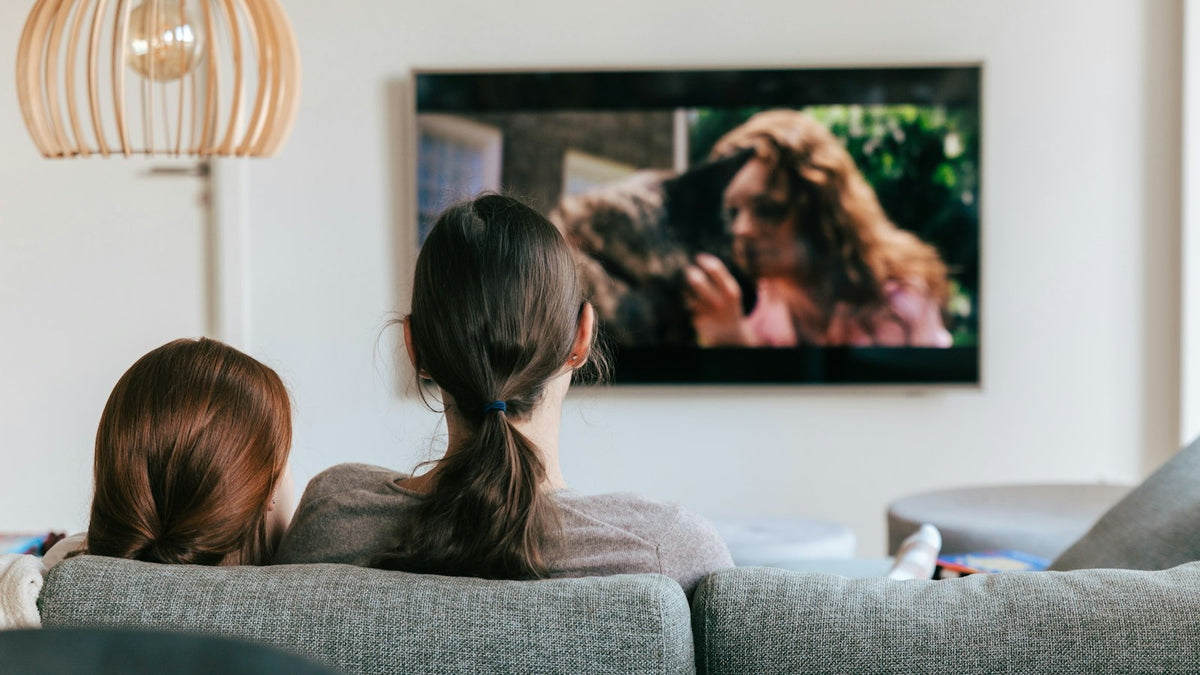
It's one of the most common questions when buying a new TV: how big should it be? Too small and you'll squint at the screen from your sofa. Too big and it can dominate the room. But getting the right size for your room makes a real difference to your daily viewing experience.
This guide gives you a practical, straightforward way to choose the perfect TV size based on your room dimensions, viewing habits, and budget.
The Simple Rule: Viewing Distance ÷ 1.5
The quickest way to find your ideal TV size is this formula: measure the distance from your sofa to the TV position (in inches), then divide by 1.5. The result is your recommended screen size.
For metric measurements (since we're in Ireland), here's the conversion:
1.5 metres → 40"–43" TV. 2.0 metres → 50"–55" TV. 2.5 metres → 55"–65" TV. 3.0 metres → 65"–75" TV. 3.5 metres+ → 75"–85" TV.
This formula is based on the viewing angle recommended by the Society of Motion Picture and Television Engineers (SMPTE), which suggests your TV should fill about 30–40 degrees of your field of vision for an immersive but comfortable experience.
Common Irish Living Room Scenarios
Small Living Room or Apartment (1.5–2m viewing distance)
If you're working with a compact space — a city apartment or a cosy living room — a 43" to 50" TV is your sweet spot. A 50" model delivers excellent picture quality without overwhelming a small room. Wall-mounting can save space and allow you to sit slightly closer.
Average Living Room (2–3m viewing distance)
This is the most common setup in Irish homes, and a 55" TV is the most popular choice for good reason. It's large enough to feel immersive for movies and sport, but not so large that it dominates the room. A 55" 4K TV at this distance delivers exceptional detail and sharpness.
If your budget allows, stepping up to 65" at this distance is genuinely worth considering. It makes the biggest difference for films and sport.
Large Living Room (3m+ viewing distance)
For spacious living rooms, a 65" to 75" TV comes into its own. At 3 metres or more, a 55" TV can start to feel a little small. A 65" model fills your field of vision beautifully and makes sport, movies, and gaming genuinely cinematic.
Bedroom TVs
For bedrooms, where you're typically watching from a shorter distance (1.5–2m), a 32" to 43" TV works perfectly. Since bedroom viewing is often more casual — catching up on series before sleep, morning news — you don't need the same immersive size as your main living room.
Does Resolution Matter for Size?
Yes, but not as much as it used to. With 4K resolution now standard on all TVs 43" and above, you can sit closer to larger screens without seeing individual pixels. The rule of thumb used to be to sit further back from bigger screens, but 4K's pixel density means you can comfortably sit at 1.5x the screen diagonal (our formula above) even on a 75" TV.
This is one of the reasons bigger TVs have become so popular — 4K makes large screens look sharp at normal viewing distances.
Wall-Mounted vs Stand: Does It Affect Size Choice?
Wall-mounting your TV has a few benefits for size selection. It places the screen flat against the wall, which means you can go slightly bigger than you might with a stand. A wall-mounted 65" TV in an average living room looks proportional and elegant, whereas the same TV on a deep stand might feel like it's crowding the space.
If you're wall-mounting, you can typically go one size up from what the distance formula suggests. Just ensure your wall is suitable for the weight of the TV and you use a properly rated bracket.
Common Mistakes to Avoid
Buying too small "to be safe" — This is the most common TV sizing mistake. A TV can look smaller on your wall than it did in the shop, so measure your viewing distance and use the formula above rather than guessing.
Not measuring first — Always measure your viewing distance and the space where the TV will sit before you shop. Check the width of your TV unit or wall space to ensure the TV fits.
Ignoring the stand width — Some TVs have wide-set legs that need a TV unit wider than the screen itself. Check the stand dimensions if you're not wall-mounting.
Our Recommendation
For the average Irish home, 55" is the minimum you should consider for a main living room TV in 2026, with 65" the step up to consider for a more immersive picture. Browse the full range of TVs at Euronics.ie to compare sizes, technologies, and prices — and remember, when in doubt, go bigger.
Buying Tips for Irish Shoppers
When shopping for TVs in Ireland, timing your purchase can save you a significant amount of money. The best times to buy are during Black Friday sales in November, January sales after Christmas, and during bank holiday weekends when retailers frequently run promotions. Keep an eye on Euronics.ie for regular deals and seasonal offers.
Before you buy, check the EU energy label. Every TV is rated from A to G for standard pictures, with a separate class for HDR, and the label shows its energy use in kWh per 1,000 hours. Larger, brighter screens usually sit lower on the scale, so compare models of the same size.
Check the delivery options for larger screens, and measure doorways and stairs if you are buying a 75" TV or bigger. Under Irish WEEE rules, retailers take back your old TV free of charge when you buy a new one of the same type.
What to Consider Before You Buy
Before making your final decision, measure the space where the TV will go: the width of your TV unit or wall, and the height you want the screen at. Check where your aerial, broadband and power sockets are, and leave room for a soundbar if you plan to add one.
Think about how you watch. If you stream most of your TV, check that the smart platform has the apps you use. If you play on a PS5 or Xbox, look for HDMI 2.1 ports and 120Hz support. In a bright room, an LED, QLED or Mini LED TV holds up better against daylight than an OLED.
To compare running costs, look at the energy use figure on the EU energy label, given in kWh per 1,000 hours: the lower the figure, the less electricity the TV uses while it is on.
Frequently Asked Questions
What size TV is best for a 2.5 metre viewing distance?
At 2.5 metres, a 55 inch to 65 inch TV is ideal. A 55 inch is the minimum recommended size, and 65 inch will feel more immersive for movies and sport. With 4K resolution, both sizes look sharp at this distance.
Is a 55 inch TV big enough for a living room?
For most Irish living rooms with viewing distances of 2–2.5 metres, 55 inch is a great all-rounder. However, if your room allows it, 65 inch provides a noticeably more immersive experience. If you sit 2.5 metres or more away, 65 inch is the better fit.
Can a TV be too big for a room?
Technically yes, but in practice it's rare with modern 4K TVs. The high resolution means you can sit closer without seeing pixels. The only concern is if the TV physically doesn't fit in your space. Measure your wall or TV unit width carefully before buying.
What size TV for a bedroom?
For bedrooms, a 32 inch to 43 inch TV is usually perfect. The shorter viewing distance (typically 1.5–2 metres) means you don't need a large screen, and a smaller TV keeps the room feeling relaxed rather than dominated by a screen.