Right to Repair in Ireland: What It Means When You’re Buying Appliances and Electronics
When a washing machine, fridge freezer, TV or vacuum cleaner breaks down, the big question is usually simple: should you repair it, replace it, or start shopping for something new?
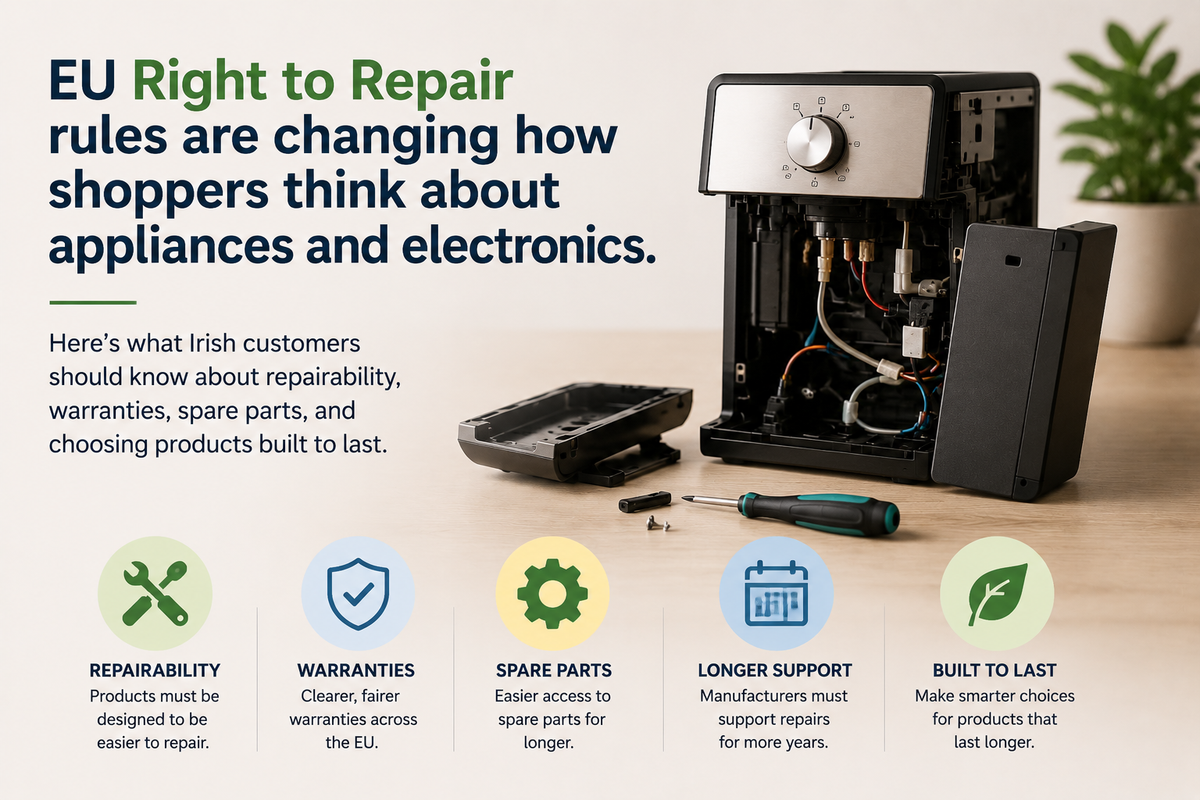
That question is becoming more important in 2026. Across the EU, new Right to Repair rules are designed to make it easier for consumers to keep products working for longer, reduce unnecessary waste, and make repair a more realistic option when something goes wrong.
For Irish households, this does not mean every appliance will suddenly be repairable forever, or that every repair will be free. But it does mean repairability, spare parts, warranty cover, and product lifespan are becoming bigger parts of the buying decision.
Here is what to know before you choose your next washing machine, tumble dryer, fridge freezer, dishwasher, TV or vacuum cleaner.
What is Right to Repair?
Right to Repair is the idea that consumers should have better access to repairs when a product develops a fault, instead of being pushed too quickly towards replacement.
The EU’s new repair rules aim to encourage people to use products for longer by improving access to repair services, spare parts, and clearer repair information. The European Commission says the rules are intended to prevent the premature disposal of repairable goods and to complement existing ecodesign requirements, which already cover areas such as product design and spare-part availability.
In practical terms, this means repairability will become a more visible part of the product lifecycle. When you are buying an appliance or electronic product, it will be worth thinking not only about the upfront price and features, but also about how easy the product may be to maintain, service, and keep running over time.
Why 2026 matters for Irish shoppers
The EU Directive on common rules promoting the repair of goods must be transposed into Irish law by 31 July 2026. Ireland’s Department of Enterprise, Trade and Employment has listed the Directive under its 2026 transposition timetable, with the Competition and Consumer Policy Unit responsible.
Once implemented, the rules are expected to strengthen repair options for covered goods and make repair information easier for consumers to compare. The European Commission has also said a European online repair platform is planned for 2027, designed to help consumers find repairers more easily.
For now, shoppers should see this as a sign of direction: repair, durability, and long-term value are becoming more central to the way appliances and electronics are bought, sold, and supported.
Which products are likely to matter most?
The repair obligation is linked to product categories that already have EU repairability requirements under ecodesign rules. These include many everyday electrical categories that Irish households rely on, such as:
- Household washing machines and washer dryers
- Household dishwashers
- Refrigerating appliances, including fridge freezers
- Electronic displays, including televisions and monitors
- Vacuum cleaners
- Mobile phones and tablets
- Household tumble dryers
That makes the rules especially relevant for big-ticket purchases. If you are replacing a major home appliance, the best choice is not always the cheapest model on the day. It is often the product that gives you the right mix of performance, efficiency, support, repairability, and expected lifespan.
Repair does not replace your Irish consumer rights
It is important to separate three things: consumer rights, manufacturer guarantees, and optional warranties.
In Ireland, the Competition and Consumer Protection Commission explains that products must be of good quality, as described, durable, and free from faults. If there is a problem with a product you bought from a business, you may have a right to a repair, replacement, refund, or price reduction depending on the circumstances.
The CCPC also states that consumer rights are strongest soon after purchase, including a short-term right to a refund within 30 days for a confirmed fault. After 30 days, repair or replacement will often be the first route, with refunds available in certain situations, such as where a repair does not resolve the issue.
A guarantee is usually provided by a manufacturer or business for a set period. A warranty, including an extended warranty, is optional cover that may help with repair or replacement costs depending on the terms. Euronics Ireland’s Brightside Extended Warranty page, for example, explains cover for repair or replacement costs following mechanical or electrical breakdown, including call-out, labour, transportation, replacement parts, and VAT, subject to the policy terms.
What to check before buying a repairable product
Right to Repair is useful, but shoppers still need to make smart choices at the point of purchase. Before buying a new appliance or electronic product, consider the following:
- Brand support: Choose established brands with clear after-sales support and accessible product information.
- Warranty and guarantee terms: Check what is covered, how long cover lasts, and whether registration is required.
- Spare-part availability: For major appliances, ask whether common parts are typically available and how servicing is handled.
- Energy efficiency: A product that costs less to run can offer better lifetime value, especially for appliances used every day.
- Installation and setup: Correct installation can help avoid avoidable faults and performance issues.
- Repair versus replacement cost: For lower-cost items, replacement may still sometimes make more sense, while major appliances are often worth assessing for repair first.
If you are buying a large appliance online, it is also worth checking delivery and access details before the product arrives. Euronics Ireland’s delivery information explains delivery options for small items, large appliances, and two-man items, as well as access requirements for large appliance delivery.
How this changes the way you compare appliances
For years, appliance comparisons have often focused on price, capacity, brand, and energy rating. Those still matter, but repairability adds another layer.
For a washing machine, look beyond drum size and spin speed. Consider how often your household washes clothes, whether you need quieter operation, whether the model has programmes you will actually use, and whether the brand has strong service support.
For a fridge freezer, think about capacity, frost-free technology, energy use, and whether the appliance suits your kitchen layout. Because refrigeration is always on, reliability and efficiency can matter as much as the purchase price.
For televisions, repairability sits alongside screen technology, size, smart TV platform, HDMI connections, and gaming features. A good TV should suit your room and viewing habits, but it should also come from a brand you trust for support.
For vacuum cleaners, check practical details such as filters, batteries, bags, brushes, and accessories. These parts can make a big difference to long-term ownership, especially in homes with pets, carpets, or heavy daily use.
Repairability and sustainability go together
Repair is not just a consumer-rights issue. It is also a sustainability issue.
Keeping appliances in use for longer can reduce unnecessary disposal and make better use of the materials already inside the product. This is especially relevant for large appliances and electronics, where manufacturing, transport, packaging, and end-of-life disposal all carry an environmental cost.
When a product genuinely has reached the end of its useful life, responsible recycling matters too. Euronics Ireland highlights free recycling as part of its customer support, and customers can learn more through Euronics’ WEEE recycling information.
When should you repair, and when should you replace?
There is no single answer, but a few practical questions can help:
- Is the product still within its consumer-rights period, guarantee, or warranty?
- Is the fault minor, or does it affect the main function of the product?
- How old is the appliance, and how heavily has it been used?
- Would a repair meaningfully extend the product’s life?
- Would a newer model reduce running costs through better energy efficiency?
- Are spare parts, service support, or repair options available?
If your appliance is relatively new, repair should usually be explored first. If it is older, inefficient, expensive to fix, or no longer suitable for your household, replacement may be the better long-term decision.
How Euronics can help you choose with confidence
Right to Repair makes one thing clear: buying an appliance is not just about the day it arrives. It is about the years of use that follow.
That is where good advice matters. Euronics Ireland offers a wide range of home appliances and electronics from trusted brands, with local stores across Ireland and online support for delivery, warranty, and product queries. Whether you are comparing energy-efficient laundry appliances, upgrading your kitchen, replacing a TV, or choosing a vacuum cleaner for everyday use, expert guidance can help you find a product that suits your home, budget, and long-term needs.
Explore Euronics Ireland’s home appliances, browse TVs, or find your nearest Euronics store for local advice.
Final takeaway
The Right to Repair movement is changing how people think about appliances and electronics. For shoppers in Ireland, the practical message is simple: choose products with long-term value in mind.
Look for the right features, the right energy performance, the right support, and the right warranty or guarantee information. A good purchase should work well on day one, but it should also be easier to live with, maintain, and support for years to come.