Electricity Prices Are Rising Again: How to Choose Appliances That Help Keep Bills Down in Ireland
Irish households have had plenty of reasons to keep an eye on electricity costs over the past few years. Now, with Electric Ireland announcing an average residential electricity bill increase from 1 July 2026, many shoppers are asking a practical question: if an appliance needs replacing, how do you choose one that will not quietly add more to the bill every month?
The answer is not always to buy the cheapest model on the shelf. The better approach is to look at the total cost of ownership: the purchase price, the energy label, the size of the appliance, and how it will actually be used in your home.
Below, we explain how Irish shoppers can compare appliance efficiency clearly, which categories matter most, and what to look for when buying laundry appliances, dishwashers, fridge freezers, and TVs.
Why appliance efficiency matters now
Electric Ireland has confirmed that from 1 July 2026 its residential electricity customers will see an average bill increase of 8%, equal to about €11.52 per month or €138.26 per year based on the estimated annual bill as defined by the Commission for Regulation of Utilities. The company also says electricity unit rates will rise by 9.5%.
That does not mean every household will see the exact same increase. Your own bill depends on your supplier, tariff, meter type, standing charge, household size, and how much electricity you use. But the direction is clear: electricity remains a major household cost, and the appliances used most often can make a real difference over time.
Recent Irish energy research backs this up. The ESRI has highlighted that Irish residential electricity prices were among the most expensive in Europe during the 2018 to 2024 period, while CSO data for April 2026 showed wholesale electricity prices were 18% higher than April 2025. In other words, efficiency is not just a nice extra. For many homes, it is now part of the buying decision.
Start with the energy label, not just the price tag
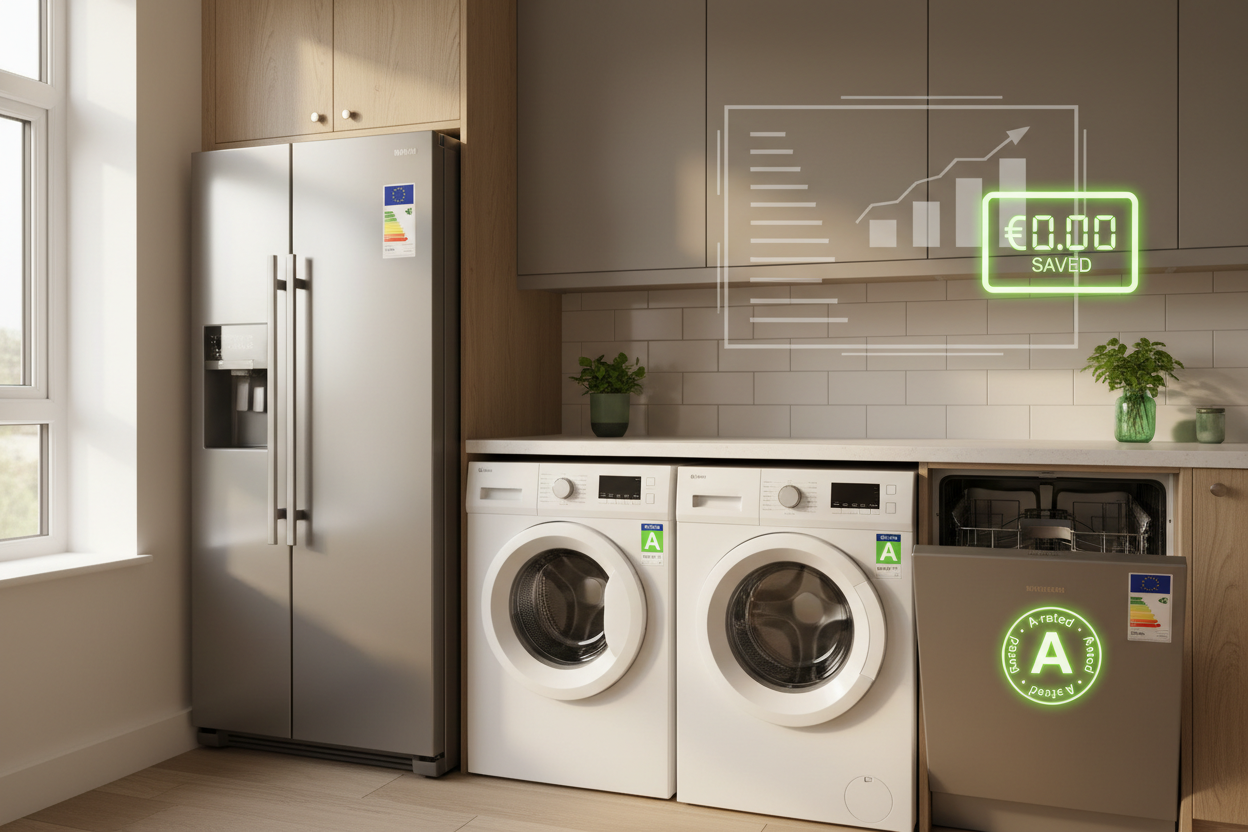
EU energy labels are designed to make appliances easier to compare. For many products, the old A+++, A++ and A+ style has been replaced by a clearer A to G scale, where A is the most efficient and G is the least efficient within that product category.
According to SEAI, the label also gives useful practical information beyond the letter rating. Depending on the appliance, this can include energy use, water use, capacity, noise level, programme time, or other performance details.
The most useful number to check is the appliance's energy consumption, shown in kilowatt-hours, or kWh. SEAI explains that energy consumption may be shown per year or per 100 cycles, depending on the product category. To estimate running cost, multiply the kWh figure by your electricity unit rate.
For example, if an appliance uses 100 kWh and your electricity unit rate is €0.38 per kWh, that portion of use costs about €38. If your tariff is higher or lower, the result changes. This is why the kWh figure is so useful: it lets you compare appliances in a way the price tag alone cannot.
Laundry: washing machines and tumble dryers
Laundry appliances are used frequently in many Irish homes, especially in families, shared houses, and homes where outdoor drying is not always practical.
When comparing washing machines, look beyond drum size and price. Check the energy label for kWh per 100 cycles, water use, spin efficiency, capacity, and noise level. A larger drum can be useful if it helps you run fewer full loads, but it may not be the best fit if you usually wash small loads.
For tumble dryers, the buying conversation has changed. From 1 July 2025, new EU energy labelling and ecodesign requirements apply to household tumble dryers, and SEAI notes that tumble dryers now use the newer A to G label format. This makes it easier to compare models directly.
If you rely on a dryer regularly, a heat pump dryer is often worth considering. Heat pump dryers usually cost more upfront than basic vented or condenser models, but they are designed to use heat more efficiently. That can make them a better long-term option for households drying clothes several times a week.
Before choosing, ask:
- How often will the dryer be used? The more you use it, the more efficiency matters.
- What capacity do you need? Match the drum size to your typical laundry load.
- Where will it be installed? Venting, room temperature, and available space can all affect the best choice.
- What does the label say? Compare kWh figures, cycle time, capacity, and noise.
Dishwashers: full loads, eco programmes, and water use
A modern dishwasher can be a smart choice for busy households, but efficiency still depends on choosing the right size and using it properly.
When browsing dishwashers, compare the energy label, place settings, water use, eco programme information, and noise rating. A larger dishwasher may suit families or frequent entertainers, while a smaller household may benefit more from flexible baskets, half-load options, or smart programme choices.
The eco programme is often the one used for energy label testing. It may run longer than a quick wash, but it is designed to reduce energy and water use for normally soiled dishes. Quick programmes are handy, but they are not always the most efficient choice for everyday use.
For lower running costs, try to:
- Run full loads where possible.
- Use the eco programme for everyday dishes.
- Keep filters clean so the machine performs properly.
- Choose a capacity that fits your household rather than buying too large by default.
Fridge freezers: the appliance that is always on
Fridge freezers deserve special attention because they run 24 hours a day. Even small differences in energy consumption can add up over the lifetime of the appliance.
When comparing fridge freezers, look at the annual kWh figure on the energy label, not just the letter rating. Also consider the total capacity, the split between fridge and freezer space, frost-free features, door layout, and whether the appliance is the right size for your kitchen and shopping habits.
A very large fridge freezer can be ideal for bigger households, batch cooking, or bulk shopping. But if the appliance is much larger than you need, you may be paying to cool unused space all year round. On the other hand, an overcrowded fridge can restrict airflow and make the appliance work harder.
Practical features can also support efficiency. Frost-free technology, good temperature controls, door alarms, and well-designed drawers can help keep food stored correctly and reduce waste.
TVs and home entertainment: check energy use on bigger screens
TVs may not be the first appliance people think of when cutting electricity costs, but screen size, brightness, and display technology can affect energy use.
If you are choosing a new television, especially a larger model, check the EU energy label and compare the kWh figure. Euronics.ie also recommends looking for energy-saving features such as eco modes and automatic brightness adjustment when comparing TVs.
The right TV is still about picture quality, room size, viewing distance, gaming needs, and budget. But for a screen that may be used every evening, energy use is worth factoring into the decision.
How to compare two appliances in under two minutes
If you are choosing between two models, use this quick comparison:
- Check the energy class. Is one appliance clearly more efficient?
- Compare the kWh figure. This gives a more precise running-cost signal than the letter alone.
- Match the capacity to your home. Bigger is not always better if you will not use the space.
- Look for practical efficiency features. Eco programmes, sensor drying, auto-dosing, frost-free cooling, and smart controls can all help when used properly.
- Think in years, not weeks. A slightly higher purchase price may make sense if the appliance is used heavily and has a lower running cost.
When should you replace an older appliance?
Replacing an appliance only makes sense when the timing is right. If your current machine is working well and used lightly, it may be better to maintain it properly and use it efficiently. But replacement becomes more attractive when an appliance is unreliable, expensive to repair, poorly suited to your household, or noticeably inefficient compared with modern models.
Signs it may be time to upgrade include:
- Repeated repair costs.
- Poor washing, drying, cooling, or cleaning performance.
- An appliance that is too small or too large for your household.
- No clear energy label information available.
- High usage in a category where newer models are significantly more efficient.
If you are replacing more than one appliance, start with the one used most often or the one that runs continuously. For many homes, that means refrigeration first, then laundry and dishwashing.
Shop energy-efficient appliances at Euronics.ie
For Irish households, appliance efficiency is now a practical buying priority. The best choice is not always the appliance with the lowest upfront price, or the one with the most features. It is the one that fits your household, performs reliably, and keeps running costs in check over time.
You can compare energy-conscious options across energy-efficient appliances, washing machines, heat pump dryers, dishwashers, and fridge freezers at Euronics.ie.
Before you buy, check the energy label, compare the kWh figures, and choose the model that matches how your home really works. That is the simplest way to make a confident purchase in a high-cost electricity environment.