How To Keep Your Home Cool This Summer Without Wasting Electricity
Irish summers can still be unpredictable, but warmer spells are becoming a bigger part of home life. Met Éireann reported that spring 2026 was Ireland’s third warmest spring since 1900, while May 2026 brought above-average temperatures everywhere and record May maximum temperatures at 18 stations. Its extended outlook also signals above-average temperatures for July, August, and September.
For households, that means summer comfort is no longer just about opening a window and hoping for a breeze. The right mix of habits and appliances can help keep bedrooms, living rooms, home offices, and kitchens more comfortable, without sending electricity use higher than it needs to be.
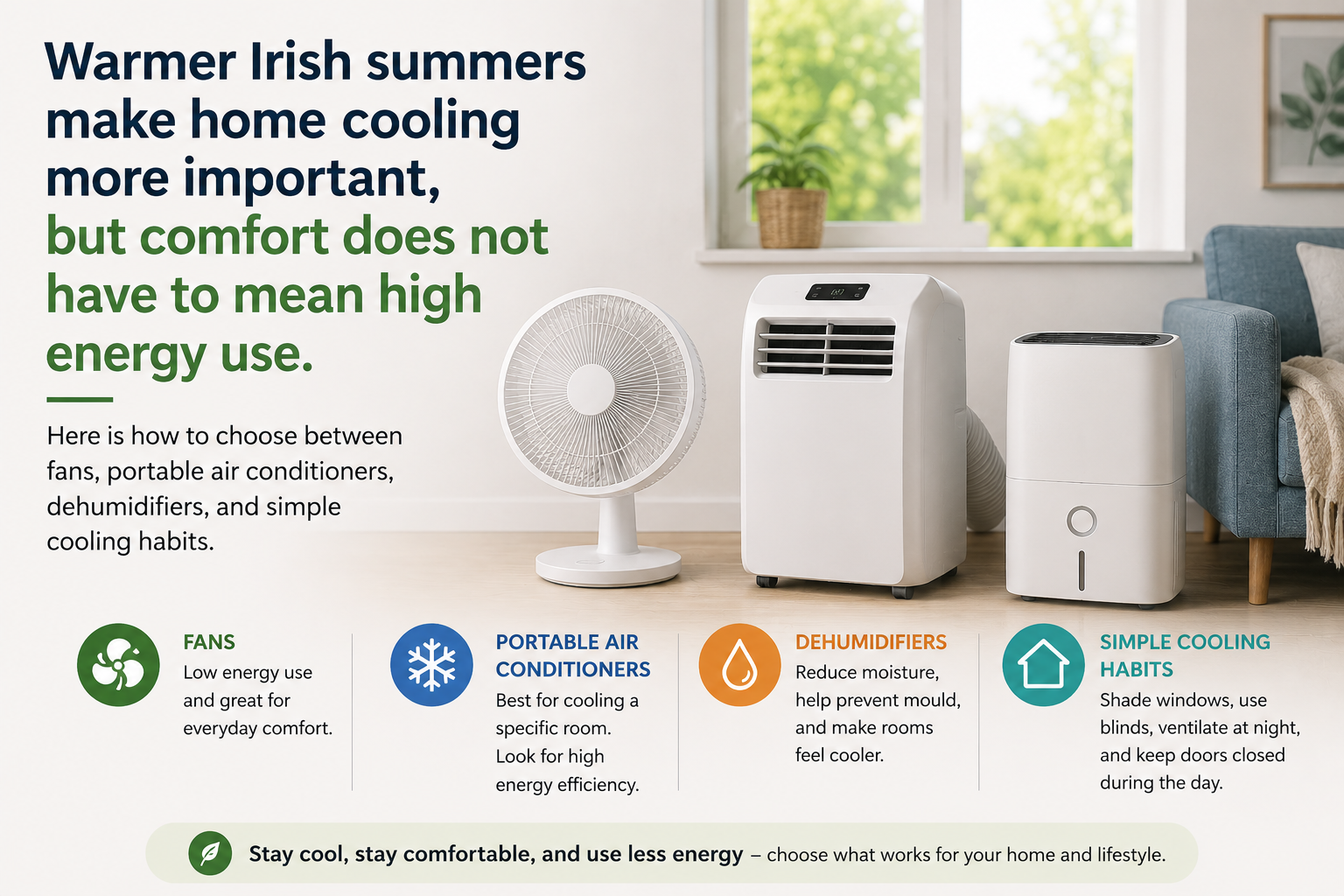
This guide explains when to use a fan, when a portable air conditioner makes sense, where a dehumidifier can help, and how to keep your home cooler before you switch anything on.
Start With The Lowest-Cost Cooling Steps
Before choosing a cooling appliance, it is worth reducing the amount of heat building up inside your home. The HSE’s hot-weather guidance recommends simple indoor steps such as closing curtains in sunny rooms, closing sun-facing windows during the day, opening windows at night when temperatures drop, and turning off lights and appliances that are not in use because they generate heat.
These small changes matter because they reduce the work any cooling product has to do. A fan will feel more effective in a shaded room. A portable air conditioner will cool a room faster if direct sun is blocked. A dehumidifier may be more useful if moisture is being managed at the same time as ventilation.
- Close curtains or blinds in rooms that get strong morning or afternoon sun.
- Open windows later in the evening when the outdoor air is cooler than the indoor air.
- Switch off unused appliances, chargers, lamps, and screens that add background heat.
- Cook smarter on hot days by using smaller appliances where suitable, rather than heating the kitchen with a full oven.
- Cool the person, not just the room, with light clothing, cool drinks, and damp cloths where appropriate.
Use A Fan For Everyday Personal Cooling
For many Irish homes, a fan is the simplest summer cooling choice. A fan does not lower the room temperature in the same way as air conditioning, but it moves air across your skin, which can make you feel cooler and more comfortable.
Fans are best for bedrooms, living rooms, home offices, and small spaces where you mainly need airflow rather than active cooling. They are also useful in rented homes or smaller rooms where a portable air conditioner may not be practical.
When choosing from the cooling and fans range at Euronics.ie, think about where you will use it most. A desk fan suits a home office. A tower fan is often easier to place in a bedroom or living room. A floor or pedestal fan can help move air through a larger space.
Consider A Portable Air Conditioner For Rooms That Get Too Warm
If a room regularly becomes uncomfortable during warm weather, a portable air conditioner may be the better option. Unlike a fan, an air conditioner actively cools the air. This makes it more suitable for heat-trap rooms, attic spaces, bedrooms that hold heat overnight, or home offices with screens and equipment running for long periods.
The key is to choose the right size and use it efficiently. Look at the room size guidance, cooling capacity, energy rating, noise level, timer settings, and whether the unit also includes fan or dehumidifier modes.
For example, Euronics.ie lists compact 3-in-1 models such as the Black & Decker 5000 BTU Smart Air Conditioner, which combines air conditioning, dehumidifying, and fan functions for rooms up to 14m². For larger spaces, models such as the De’Longhi Pinguino Care4Me WiFi Portable Air Conditioning Unit offer higher cooling capacity, smart controls, and dehumidifying functionality.
To keep running costs sensible, use a portable air conditioner in the room you are actually using, keep doors and windows closed while it is running, use timer settings, and avoid setting the target temperature lower than needed.
Do Not Overlook Humidity
In Ireland, a warm room can feel worse when the air is humid. A dehumidifier does not work like an air conditioner, but by removing moisture from the air it can make a room feel fresher and less heavy. It can also be useful year-round for drying laundry indoors, managing condensation, and supporting general air comfort.
If your main issue is dampness, condensation, or muggy indoor air rather than high temperature alone, browse dehumidifiers at Euronics.ie. Many models include features such as humidistats, laundry modes, timers, continuous-drain options, and portable designs with handles or wheels.
If you want one appliance that can help in more than one season, it may also be worth looking at air treatment products, including models that combine cooling and dehumidifying functions.
Match The Appliance To The Room
The best cooling choice depends on the room, the problem, and how often you expect to use it.
- Bedroom: Look for quiet operation, timer settings, sleep mode, and easy placement.
- Home office: Prioritise steady airflow, compact size, and low noise so calls and work are not disrupted.
- Living room: Consider a tower fan, pedestal fan, or larger-capacity air conditioner depending on room size.
- Kitchen: Reduce heat at the source by limiting oven use where possible and ventilating after cooking.
- Laundry or damp spaces: A dehumidifier may be more useful than a fan if moisture is the main issue.
Think About Electricity Use Before You Buy
Energy costs remain an important part of any appliance decision. The Central Statistics Office reported that wholesale electricity prices in April 2026 were 18% higher than in April 2025, although still well below their August 2022 peak. That does not mean every household bill will move in the same way, but it does make efficient usage habits worth paying attention to.
When comparing cooling appliances, check the power consumption, energy rating, room size suitability, and timer controls. A powerful unit may be worthwhile for a larger or hotter room, but it should not be used to cool empty spaces. Equally, a small fan may be the most sensible choice if you only need personal comfort while sleeping, working, or watching TV.
Smart Summer Cooling Checklist
- Block direct sun before the room heats up.
- Open windows in the evening when outdoor air is cooler.
- Use fans for personal airflow and everyday comfort.
- Use portable air conditioning for rooms that genuinely need active cooling.
- Use dehumidifiers where humidity, dampness, or indoor drying are part of the problem.
- Use timers and smart controls to avoid running appliances longer than needed.
- Keep filters clean and follow the manufacturer’s maintenance guidance.
Final Thoughts
Keeping your home cool in summer does not always mean buying the biggest appliance available. For many households, the best approach is a layered one: keep heat out during the day, use airflow where possible, manage humidity where needed, and reserve portable air conditioning for the rooms that become genuinely uncomfortable.
If you are preparing for warmer weather, explore the cooling appliances, dehumidifiers, and air treatment range available from Euronics.ie to find the right fit for your home.